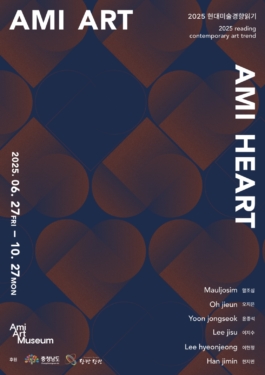

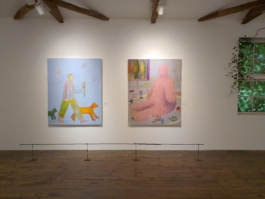
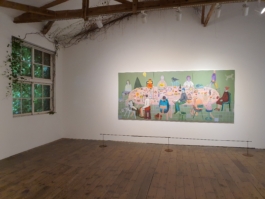
2025 Modern Art Trend Reading AMI Art, AMI Heart The heart diagram (♥), which first appeared in the 6th century BC Roman currency and Persian tableware, was a form that imitated plants and did not mean love from the beginning. It was not until medieval Europe that the heart containing romantic and religious love was dedicated and worshiped, and the heart, which simplified the heart, became a symbol of love. Since then, hearts have been universally used as the visual language of love in popular culture such as the 'I♥NY' logo, pop art, jewelry, chocolate, and emoticons. But the meaning contained in the concise form is by no means simple. Because the heart and love that are perceived differently depending on the era and culture are intertwined. The ancient Greek poet Sarpo saw love as 'a sacred madness that penetrates the heart', and in the East, the heart is included in love. The heart was considered a store of love, heart, and emotions, regardless of the East, West and the past, and the heart inherited it. This exhibition focuses on various love that comes from the heart, that is, the heart. Not only love between lovers but also feelings for family, friends, pets, things, idols, and oneself. Mauljosim seeks narcissism and recovery by facing the wounded self in the relationship between the world and others. Lee Hyunjung visualizes an individual's pain with a red heart expressed as kimchi, and shows the healing power that progresses to solidarity with others. Yoon Jongsuk metaphorically unravels the narrative of his mother, hero, and role model with objects based on everyday and historical events. Han Jimin reveals that he can form an emotional relationship with things by putting his memories with his father in a book. In addition, Lee Jisu questions the identity of love with ambiguous beings that are a mixture of reality and unreality, past and present, and Oh Jieun suggests that parting, loss, and memories are also another name of love with a glass and intense colors. Although modern science has learned that love is the work of the brain, the heart is still a metaphor for love in art, and symbolism is also valid. That's the reason why hearts are popular in an era where hatred and disgust are rampant. I hope this exhibition, which talks about heart and love, will be a small flame that re-ignites love, reflecting on the long-standing truth that 'love conquers everything'. Kim Namyoon (Director of Academic Affairs Office, Ami Museum of Art)